
- Home /
- Media /
- Publications & Research /
- Global Corporate Taxation and Resources for Quality Public Services
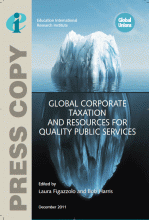
Global Corporate Taxation and Resources for Quality Public Services

FOREWORD
The current debate on sovereign debt is conducted as if there were no other option than austerity. This report changes the focus.
Here the focus is on the revenue side.
The problem with the ‘no option but austerity’ line is that it thrusts national economies into downward spirals. Austerity dampens then freezes economic activity. Public revenues drop. The objective of reducing sovereign debt is defeated because of the downturn in economic activity, while uncertainty drives up the cost of servicing the debt – the classic ‘debt trap.’
There is another way. Public revenues can be boosted, if there is political will do so. Resources injected into communities are resources invested in people, in their health, safety and education. These investments get the engines of growth moving again, they enhance equity, they provide the support structures that private enterprises need to flourish, and they help build the future. A focus on the revenue side is the way to get out of the downward spiral and to avoid the ‘debt trap.’
This report explains how the resources for investment in people can be found. Billions of dollars and Euros are lost to communities because tax laws are national while the economy is global, and that simple fact has created unprecedented opportunities for tax minimization and avoidance. Global corporations have opportunities for tax
avoidance that national enterprises do not have, let alone small business owners and wage and salary earners. Even without changing the tax laws, closing just some of these
loopholes would make a huge difference in public resources.
Closing loopholes will require changing mentalities – and political will. It means changing the widespread acceptance of tax avoidance as a legitimate goal of large corporations. To close these loopholes is to take a step towards a change of paradigms, change that would take us off the path where ultimately everybody loses and put us onto a path where most have an opportunity to win. And isn’t that what democracies and market economies are all about ?
By Bob Harris
- All News
- Press Room
- Publications & Research
- Asia Pacific news - Bulletin 2011
- Bermuda - Migration Pre-decision kit
- Canada: pre-decision and information kit
- Desertec: what are the implications for Africa?
- Ghana: pre-decision and information kit
- Global Corporate Taxation and Resources for Quality Public Services
- Membership Survey 2012 (Short version)
- PSI Focus 2011
- PSUFASA HIV/AIDS Newsletter, September 2011
- Pre-decision kit
- Replacing failed private water contracts
- South Africa National Report on Migration in Health and Social Care Sectors
- Tackling the recession: Some nations realise cuts will make things worse
- The past, present and future of finance for investment in water systems
- Water, electricity and the political context in Arab countries 2011
- Why we need public spending
- Youth to Youth - Bulletin 2011
- Annual Report 2008
- Annual Report 2009
- Annual Report 2010
- Asia Pacific News Bulletin 2012
- City of Bergkamen: Powerpoint presentation
- Closing the Gender Gap
- Conflicts, companies, human rights and water
- Defending universally-accessible quality public services: a central challenge for municipal workers unions
- Effects of contracting out public sector tasks
- Financial Transaction Tax: Myth-busting
- Financing water and sanitation: public realities
- General Report of the ILO Committee of Experts on the Application of Conventions and Recommendations
- ILO General Survey: Collective bargaining in the public service – A way forward
- ILO Manual on Collective Bargaining and Dispute Resolution in the Public Service
- Impact of the Global Economic Crisis and Austerity Measures on Women
- In the People's Interest
- International Women's Day 2012
- It’s time to end violence against women
- Kenya: Pre-decision & Information Kit
- Migration: Australia National Report
- Migration: Kenya National Report
- Migration: South Africa National Report
- Minimum wages – designs and effects
- New handbook for green workplaces
- No compromise on women’s rights Zero tolerance for violence against women and girls
- PSI Comments on ILO Report “Collective bargaining in the public service: a way forward”
- PSI Congress Resolutions
- PSI Guidelines on the Conclusion of International Agreements with Multinational Enterprises
- PSI at the World Social Forum, Tunis 2013 - Strategic Activities Report
- PSI leaflet
- Philippines: Comparative study of collective bargaining
- Philippines: pre-decision and information kit
- Posters & Badges: The Route of Shame
- Posters - 1 May 2013
- Posters - International Women's Day 2013
- Posters: Your Future in Public Hands
- Privatising Europe - Using the crisis to entrench neoliberalism
- Protecting workers and promoting social development in Brazil
- Public sector unions combating HIV/AIDS in Southern Africa
- Re-municipalising municipal services in Europe
- Remunicipalisation of public services in Europe
- Remunicipalisation: Putting water back into public hands
- Rio+20 Working for a sustainable world
- Sharp sense - Promoting the safety of healthcare workers
- Strengthening Public Services Social Dialogue in an Era of Austerity
- Sustainable development, decent work and green jobs
- Tax Justice for Social Justice
- Trade unionists together for LGBT rights!
- Training, jobs and deceent work for young people in the public sector
- Utterly Uncompetitive
- Water companies and trends in Europe
- Water, electricity and the political context in Arab countries 2011
- Why we need public spending
- World Health Worker Week Engagement Toolkit
- Youth to Youth - Bulletin 2012
- Youth to Youth - Bulletin 2013
- private government public utilities
- “Quality health care and workers on the move”
- Event calendar
- E-mail news
- Photo Galleries
- Communicators' Action Network (PSI CAN)
- Videos